

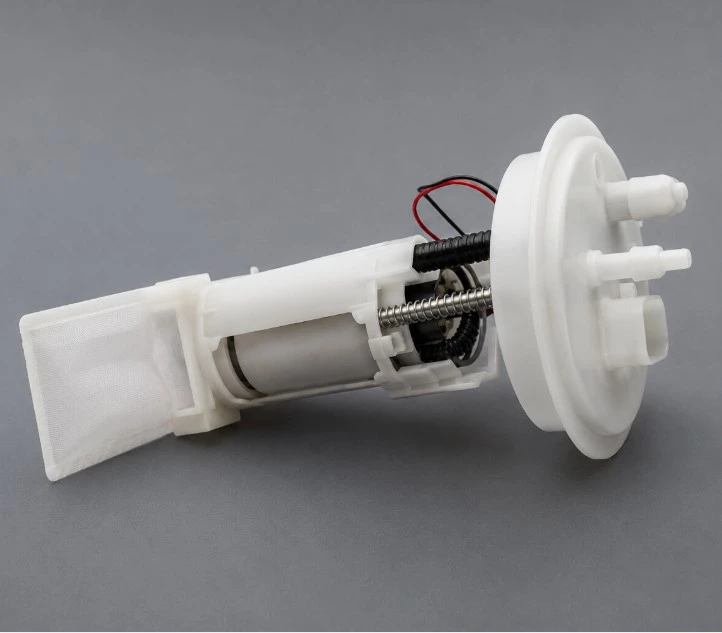
Product Overview
The in-tank fuel filter is a critical component engineered to sit directly inside the fuel tank, working in tandem with the fuel pump module. Its primary function is to capture and isolate harmful contaminants-such as dirt, rust, scale, water, and organic debris-before the fuel enters the fuel pump and the highly sensitive fuel injection system. By delivering clean, micro-filtered fuel, this product prevents fuel injector clogging, protects the fuel pump from abrasive wear, maintains optimal fuel system pressure, and ensures clean engine combustion.
Technical Specifications
|
Parameter |
Specification Details |
|
Product Category |
In-tank Fuel Filter Assembly / Element |
|
Primary Application |
Fuel Pump Module Protection |
|
Filter Media Material |
Multi-layer Cellulose, Synthetic Fiber, or Composite Media |
|
Housing / Structure Material |
High-performance Polyamide (PA66) / Corrosion-resistant Alloy |
|
Filtration Efficiency |
Up to 99% for target particle sizes |
|
Nominal Micron Rating |
2 to 30 microns (customizable based on application) |
|
Operating Temperature Range |
-40°C to +120°C |
|
Compatible Fuel Types |
Regular Gasoline, Ethanol Blends (E10, E85), Diesel, Biodiesel |
|
Operating Pressure Capacity |
Optimized for high-pressure fuel injection systems |
|
Sealing Material |
Viton / NBR (Fuel-resistant elastomeric seals) |
|
Manufacturing Certifications |
Manufactured under strict ISO-compliant quality systems |
Features & Benefits
High-Efficiency Filtration: Multi-layered structural fibers capture sub-micron particulates, protecting modern high-pressure common rail systems.
Large Dirt-Holding Capacity: Pleated design maximizes the effective filtration surface area, allowing the filter to hold more contaminants without clogging.
Optimized Flow Dynamics: Engineered for low flow restriction, ensuring a continuous and stable fuel supply even during peak engine demand.
Excellent Chemical Resistance: Built with robust polymers and treated metals that resist degradation from aggressive fuel additives, ethanol, and moisture.
Structural Durability: Heavy-duty housing prevents deformation or bypass leaks under fluctuating tank pressures and thermal cycles.
Direct Fit Integration: Manufactured strictly to precise dimensional standards, ensuring seamless installation inside the fuel tank module.
Extended Service Intervals: High-durability materials ensure a reliable operating life, reducing vehicle downtime and maintenance overheads.
Raw Materials & Sourcing Integrity
To maintain a consistent standard of excellence, we strictly source our raw materials from industry-leading, globally recognized material suppliers:
Filter Media: We utilize premium composite media, synthetic melts, and glass-fiber reinforced papers from top-tier global filtration media manufacturers, ensuring precise pore sizes and high tear resistance.
Plastics and Polymers: All molded housings and internal structural supports are manufactured using virgin PA66, POM, or specialized engineering plastics formulated for continuous fuel immersion.
Adhesives and Sealants: We apply high-performance, heat-curing polyurethane or plastisol compounds that guarantee 100% bypass-free sealing between the media and the end-caps.
Testing & Quality Control Standards
Every production batch undergoes a battery of quality verification processes in our in-house testing facility to ensure zero-defect shipments:
Bubble Point Test (ISO 2942): Verifies fabrication integrity and confirms the absence of manufacturing bypasses or structural micro-leaks.
Filtration Efficiency & Dust Holding Capacity (ISO 19438): Measures the filter's precise particle separation efficiency and life expectancy under simulated heavily contaminated fuel conditions.
Differential Pressure vs. Flow Rate: Confirms that the filter offers minimal flow resistance, protecting the electric fuel pump from overheating or cavitation.
High-Temperature Fuel Aging Test: Evaluates material stability by submerging components in simulated fuel mixtures at elevated temperatures for extended periods.
Applications & Suitability
Our in-tank fuel filters are designed to provide clean fuel across a broad range of demanding operating sectors:
On-Road Transportation: Light-duty passenger vehicles, heavy-duty logistics trucks, municipal transport buses, and delivery vans.
Off-Road Construction Machinery: Crawler excavators, wheel loaders, track-type tractors, backhoes, and mobile cranes.
Agricultural Machinery: High-horsepower tractors, combine harvesters, field sprayers, and utility vehicles.
Power Generation: Stationary standby diesel generators, prime power systems, and mobile rental power units.
Specialized Motive Power: Marine inboard/outboard engines, all-terrain vehicles, and commercial turf care equipment.
Customization & Manufacturing Workflow
We provide complete custom manufacturing solutions tailored to the unique technical and commercial requirements of our global clients.
Step 1: Technical Requirement Analysis: You provide the physical samples, detailed drawings, target micron ratings, or specific dimensional constraints.
Step 2: Engineering Design & Modeling: Our engineering department generates comprehensive 3D CAD models and fluid flow simulations to optimize filter performance.
Step 3: Rapid Prototyping: We produce initial functional samples using precision molding or CNC machining for physical fitting and preliminary bench testing.
Step 4: Strict Performance Testing: The prototype undergoes structural integrity, flow restriction, and filtration efficiency testing under simulated field conditions.
Step 5: Mold Development & Tooling: Upon your approval of the physical samples, we design and manufacture high-precision injection molds for stable, high-speed mass production.
Step 6: Mass Production & Quality Assurance: Bulk production is executed on our automated assembly lines, with inline quality checks and final batch testing before packaging.
Packaging, Storage & Export Logistics
Dust-Free Protection: To prevent particulate contamination before installation, each in-tank fuel filter is individually sealed in airtight, anti-static polybags.
Robust Outer Packaging: Individual units are placed in reinforced, moisture-resistant neutral boxes, then packed into heavy-duty double-wall corrugated export master cartons.
Secure Palletization: Master cartons are stacked on fumigated plastic or wooden pallets, wrapped securely with heavy-duty stretch film, and bound with edge protectors to prevent shifting or crushing during sea transport.
Flexible Shipping Options: We offer comprehensive coordination for Ocean Freight (FCL/LCL), Air Freight, and Express Courier shipments, providing complete customs documentation, commercial invoices, and certificates of origin.
FAQ
Hot Tags: in-tank fuel filter, China in-tank fuel filter manufacturers, suppliers, factory, 21196919, C16302, fuel contamination filter, fuel separator filter, fuel strainer, truck fuel filter